Varg Vikernes
Lords of ChaosVarg Vikernes is a Norwegian musician and political polemicist whose importance to the Black Metal scene grew well beyond his recordings: he helped give its emerging anti-Christian and heathen outlook a conspicuous public voice, while his crimes, media performances, and imprisonment made him one of its most notorious figures. Known at different times as Kristian Vikernes, Count Grishnackh, and later Varg Qisling Larssøn Vikernes, he moved from a young musician in Bergen to an imprisoned writer whose influence and public image continued to be contested.
Identity and Musical Formation
Vikernes grew up in Bergen, where he was described as an energetic teenager with a long-standing interest in guitar. He joined the Death Metal band Old Funeral but soon became dissatisfied with what he regarded as the group’s superficiality and juvenile concerns. The band nevertheless gave him access to musicians and acquaintances who would become important to the Norwegian Black Metal scene, including members who later formed Immortal and Øystein Aarseth, better known as Euronymous.
After leaving Old Funeral, Vikernes formed a one-man project to retain control over his work. He first called it Uruk-Hai, after a reference in J. R. R. Tolkien’s The Lord of the Rings, and later renamed it Burzum, a name he also found in Tolkien and which means darkness. He founded the project in 1991 under the alias Count Grishnackh. The solo format was not incidental: it allowed him to make the music on his own terms, while the name and persona placed the work within a deliberately mythic, obscure register.
Vikernes initially entered the scene using his given name, Kristian. In his late teens, he came to regard that name as intolerable and legally changed it to Varg sometime in 1991–92. He later said he chose Varg chiefly for its common meaning of wolf. The account notes that the word has older Germanic associations, but finds no evidence that he knew of those when he chose it; the ominous significance attached to the name therefore belongs partly to the legend that developed around him, rather than to an established motive for the change.
Burzum, the Scene, and Public Persona
Vikernes’s relationship with Euronymous began as a friendship. When Vikernes was still little known and began talking about Burzum, he had soon recorded its first album. Euronymous was excited by what he heard, regarding it as extreme and new, and the two became close. Their later rupture is therefore presented not as a simple clash between strangers, but as a reversal in a relationship that had once been close and creatively encouraging.
Norwegian Black Metal was not governed by a fixed rulebook. Its identity depended as much on musicians’ beliefs and attitudes as on sound, and the boundaries of its ideology shifted over time. The scene was also shaped by prominent personalities, whose forceful self-presentation could help determine what counted as serious or authentic. In this setting, Vikernes’s music, opinions, and public behavior became intertwined. Burzum was part of a wider network that included Mayhem, Emperor, Enslaved, Immortal, Darkthrone, and other acts, while Vikernes’s own identity as Count Grishnackh gave listeners and journalists a vivid persona to attach to the music.
The book stresses that media attention helped turn that persona into something close to legend. In early interviews, Vikernes adopted an evasive, suggestive manner around rumors of violence, hinting at disappearances and refusing to answer directly when asked whether he had killed anyone. The account interprets this performance as a deliberate way of cultivating subcultural credibility, while noting that journalists and Christian sources had already circulated stories that young would-be Satanists could imitate. Media coverage gave Vikernes a means to build an intimidating image, but it also helped make that image larger than the music itself.
His public importance was not only a product of press attention. The book argues that he gave focus to ideas already present in parts of the scene and helped lead some participants from statements and symbols toward action. Vikernes himself claimed a formative role in the church arsons, while the evidence also places him within a scene whose members did not share a single doctrine or identical motives. His influence is presented as substantial, though never as proof that he alone determined the scene’s course.
Heathen Beliefs and the Church Arsons
Vikernes described Christianity as an alien force that had destroyed what he considered Norway’s beautiful, authentic culture: the heathen past. He framed church arson as retaliation and as an instinctive uprising against Christianity, rather than as an ordinary property crime. Burzum, in this account of his thinking, could function as a weapon that encouraged such a revolt. Yet he also described the project as a dream intended to stimulate fantasy, a formulation that sets imaginative art beside his assertions that music should have consequences in the world.
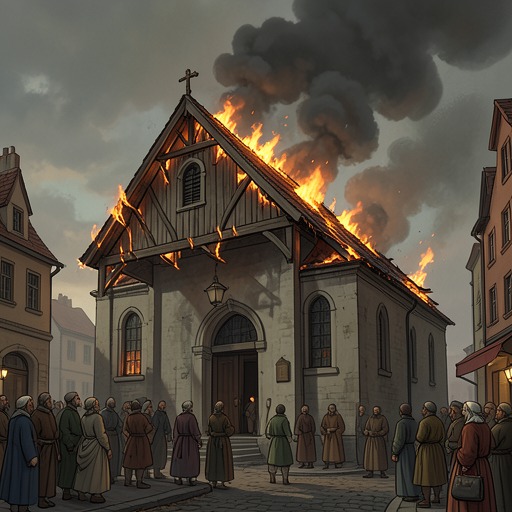
The book distinguishes those claims from what was established in court. Vikernes was accused of burning two churches and was imprisoned from January to March 1993, but released when authorities could not prove his connection to the arsons. He was not found guilty of burning Fantoft Stave Church. In a later account, he rejected the idea that there was an organized body behind the fires, while claiming that one person had started the wave and that the Fantoft fire triggered it. He also recalled that the date, June 6, 1992, led people to associate the blaze with Satanism.
In a January 1993 interview, Vikernes said he knew who had burned the churches. He later claimed that public attention to the case helped awaken interest in Odin and Norse mythology. That is his interpretation of the arsons’ cultural effect, not a demonstrated measure of their influence. The book sets it alongside the wider context: church burners, including Vikernes, commonly portrayed their crimes as justified revenge against Christianity, while the fires also generated solidarity for the congregations whose churches were attacked. One analysis characterizes such crimes as resembling revenge-motivated arson, while emphasizing that the actions were to a considerable degree unprecedented.
Vikernes also encouraged the idea that artistic conviction should be carried into action. In commentary associated with the Svarte Sirkel, arson is defended as psychological rather than economic warfare: its purpose, in this argument, is to threaten many through the destruction of one building, even when a congregation may rebuild. Such arguments illuminate the scene’s effort to make transgression signify more than spectacle. They do not erase the distinction between Vikernes’s advocacy, his claims about the fires, and the court’s inability to establish his responsibility for Fantoft.
Euronymous, Arrest, and Imprisonment
The friendship between Vikernes and Euronymous gave way to a deadly conflict. One account dates their dispute to August 10, 1993, and suggests that rights to Burzum recordings and a large sum of money were at issue. The conflict escalated into a fight in which Vikernes stabbed Euronymous to death. After four days of investigative work following an interview with Ilsa Raluce Anghel, police arrested Vikernes in Bergen on August 19, 1993. Investigators gathered enough evidence to charge him with more than the killing; the book also describes the Magne Andreassen murder as a separate case that had remained unsolved, and does not present it as part of the evidence against Vikernes in this arrest account.
In spring 1994, Vikernes was sentenced to twenty-one years in prison, the maximum sentence in Norway. The trial and the publicity surrounding the killing brought Black Metal and what one account calls its occulture into newspapers and magazines. Some record shops and distributors refused to carry Burzum and other Norwegian bands, even as bootleg Burzum recordings appeared. The legal outcome thus affected both Vikernes’s life and the circulation of the music associated with him: exclusion from some legitimate outlets coincided with unauthorized distribution.
The book also describes a wider trajectory of escalation. Not long before his final arrest, Vikernes had stolen approximately 330 pounds of dynamite. Claims differed over whether he intended to target a cathedral in Trondheim or an anarchist squat in Oslo, so the intended use remains uncertain. The account presents the theft as evidence of the scale and danger of the ambitions surrounding him, without resolving which target, if either, was actually planned.
Prison Writing, Politics, and the Continuing Image
During his first year in prison, Vikernes turned to writing. He set down his views of Norse gods and tribal practices, treating them as archetypal values that could be reawakened in the modern world. He also defended the crimes for which he had been sentenced: he framed Euronymous’s killing as self-defense and argued that the burning and vandalism of nearly fifty churches in Norway were necessary to rescue Norwegians from what he called their Judeo-Christian slumber. These are his justifications, not findings that the book treats as established fact.
The imprisonment did not end his political activity. In a letter received after the book’s interviews had taken place, Vikernes said that he had changed his name to Varg Qisling Larssøn Vikernes. The added name invoked Vidkun Quisling, whom Vikernes honored in a dedication in his writings, and reflected the increasingly explicit nationalist direction of his public thought. His prison writings combined heathen revivalism with political argument, while his access to journalists and private correspondence allowed him to continue circulating those positions from confinement.
By 1997, the relation between Black Metal figures and organized far-right politics appeared, in the book’s account, to have changed. Vikernes had previously been associated with extremist movements through shared slogans and symbols; he now appeared to provide inspiration to actual members of the revolutionary right. The group known as Einsatzgruppe supported him, and some radical skinhead magazines published interviews and articles about him. The extent to which established extreme-right groups accepted his views remained unclear. The book therefore describes a connection that was real but uneven, rather than a settled alliance across all such groups.
The April 1997 headlines about a plot to kill progressive politicians and religious leaders introduced Vikernes to readers in a striking role: not as one of the plotters, but as the imprisoned comrade the alleged conspirators hoped to free and smuggle out of the country. The distinction matters. The episode demonstrates that his notoriety and political symbolism had become useful to others, while the evidence presented here does not establish that he participated in their alleged plan. By this stage, the musician’s image had moved beyond the underground scene into national political news.
The book’s portrait remains deliberately uneasy about the reach of that image. It describes Vikernes as a figure who focused elements of the scene’s outlook and repeatedly tried to convert them into action, while also showing how interviews, aliases, music, and rumor magnified his influence. An assessment calls him a self-proclaimed martyr and prophet of his ideals, admiring his conviction while questioning his grasp of reality. In prison, Vikernes joked that time passed quickly and compared his isolation to the chosen seclusion of a monk or hermit, a condition that gave him time to study and formulate strategy. The account estimated that, depending on how authorities calculated his remaining sentence, release might come in 2005 or 2007. Its closing emphasis is not on a resolved transformation, but on the persistence of a public figure whose confinement could restrict his actions without ending his attempts to shape how his beliefs were understood.